
Film and Human Flourishing: A Series of Talks from around the Globe
Drawing on insights from scholars and practitioners from around the globe, this series of talks situates practices of cinematic production, curation, and viewing in the context of human flourishing and public value.
An evolving phenomenon, the cinema is commonly understood to have expanded in response to technological innovations (e.g. the invention of sound, color stock, 3D technologies, or computer-generated images). What has been largely overlooked is the extent to which the cinema is currently being transformed by pressures arising from changing social expectations, especially as these relate to diversity, inclusion, and recognition, and to the requirements of a dignified life.
If cinema in the wake of the talkies was a phenomenon situated within a normative space where viewers were assumed to be cognitively functional and fully in possession of the senses of sight and hearing, moving images are now increasingly mobilized in contexts of disability, medical treatment, and impairments caused by aging. Also, whereas harms incurred during cinematic production were once public secrets, such harms are increasingly considered unacceptable and profoundly at odds with the idea of cinematic works having aesthetic and artistic value.
In short, there is considerable and clearly growing interest in seeing cinema through the lens of human flourishing, as a means of achieving a measure of well-being across a human lifespan or during periods of illness; or as a way of making rich sensory experiences available to disabled communities in the context of an appropriately inclusive society. Equally important is the now unavoidable demand that involvement in the creative industries, as a practitioner, should be compatible with human flourishing. That is, the conditions of creative work should be conducive to physical and psychological health.
Talks featured in the Film and Human Flourishing series examine the different dimensions of the ongoing transformation of the cinema with an eye to capturing the cinema’s potential as a vehicle for public value based on human well-being.
Session 1:
Film and Person-centred Dementia Care
Date: 16 Dec. 2025 (TUE.)
Time: 16:30–18:00 (HKT, GMT+8)
Location: Online via Zoom
Speaker: Dr. Anders Møller Jensen (Research Centre for Care and Rehabilitation, VIA University College, Denmark )
Respondent: Dr. Rob Dean (Lincoln School of Creative Arts, University of Lincoln ,UK)

Anders Møller Jensen will present his research on how film can be used as a powerful tool in person-centred dementia care. His presentation explores how film media can evoke memories, create emotional connections, and strengthen identity among people living with dementia. The presentation demonstrates how film-based approaches can foster meaningful conversations and improve the quality of life for people with dementia, and discusses the political framework in Denmark that enabled this development.
Session 2:
The Sacred Cinema of Asakusa: An Art of Possession
Date: 21 Jan. 2026 (WED.)*
Time: 3:30–5:00 pm (HKT, GMT+8 | 7:30-9:00 am UK Time)
Location: Online via Zoom
Speaker: Dr. Phillip Warnell (Lincoln School of Creative Arts, University of Lincoln, UK)
Respondent: Dr Justine Atkinson (School of Culture & Creative Arts, The University of Glasgow, UK)
* Postponed due to the Tai Po fire tragedy. Originally scheduled on November 27th, 2025, as kick start talk for this series.
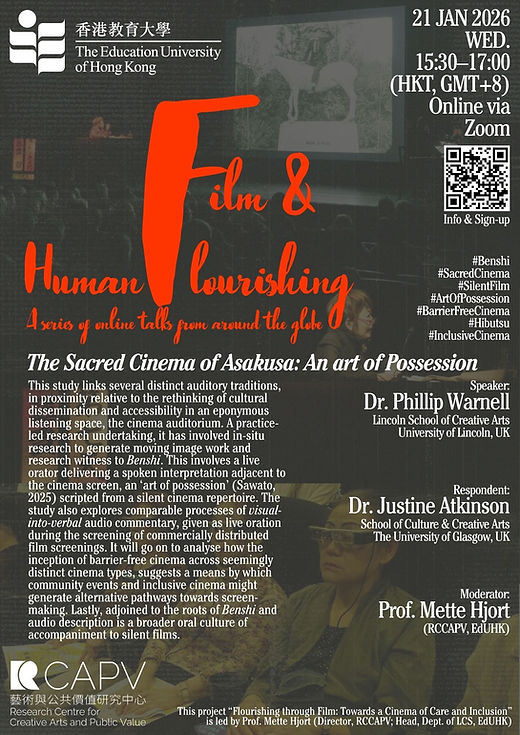
This study links several distinct auditory traditions,
in proximity relative to the rethinking of cultural
dissemination and accessibility in an eponymous
listening space, the cinema auditorium. A practice-
led research undertaking, it has involved in-situ
research to generate moving image work and
research witness to Benshi. This involves a live
orator delivering a spoken interpretation adjacent to
the cinema screen, an ‘art of possession’ (Sawato,
2025) scripted from a silent cinema repertoire. The
study also explores comparable processes of visual-
into-verbal audio commentary, given as live oration
during the screening of commercially distributed
film screenings. It will go on to analyse how the
inception of barrier-free cinema across seemingly
distinct cinema types, suggests a means by which
community events and inclusive cinema might
generate alternative pathways towards screen- making. Lastly, adjoined to the roots of Benshi and
audio description is a broader oral culture of
accompaniment to silent films.
Session 3:
Projected Light, Persistent Meaning: Cinema and the Search for Understanding
Date: 20 March. 2026 (FRI.)
Time: 3:30–5:00 pm (HKT, GMT+8)
Location: D2-LP-02 EdUHK Taipo Campus & ZOOM
Speaker: Dr Kingsley Marshall (Head of the School of Film & Television, Falmouth University, UK)
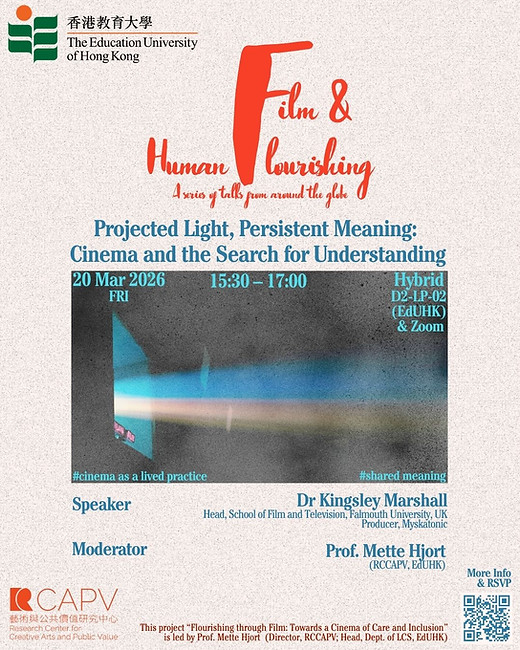
Periods of political upheaval and warfare disrupt shared meaning and destabilize notions of truth. As the future grows opaque, shaped by the impact of emerging technologies and eroding institutional credibility, cinema offers a form of orientation, teaching us how to see, attend, and endure. The cinematic projector requires darkness to function, yet its light is sufficient to gather an audience, focus our attention, and render complex experiences newly legible.
From his work with students in the UK within Falmouth University’s Sound/Image Cinema Lab in the UK, and his own work as a producer at Myskatonic, Kingsley will argue that flourishing is not defined by comfort or happiness, but by the manner with which filmmakers and audiences respond to fear, suffering, and mortality. A meaningful life must include the capacity to confront darkness without surrendering one’s humanity.
Session 4:
IMPACT PRODUCING: Harnessing the power of film, TV and immersive media to change the world
Date: 27 March. 2026 (FRI.)
Time: 3:30–5:00 pm (HKT, GMT+8/ 8:30-10:00 am, Paris Time)
Location: Online via Zoom
Speaker: Dr. Julia Hammett-Jamart PhD (Impact Producer; Managing Director, Catalyst Films)
Respondent: Dr. Pengnan Hu (Post-doctoral Fellow, EdUHK)

When one makes a film about an important subject – a political, social or environmental injustice – one is generally motivated by the hope that one’s film will make a difference. The difficulty is to be sure that any sense of moral outrage, astonishment or indeed of hope and inspiration experienced by the viewing public is transformed into actual engagement. Social impact campaigns exist to accompany a film beyond the screen and out into the world, creating the tools and opportunities for it to become a vector of change. How, though, does one make the leap from having a film with a compelling issue at its core to actually triggering the changes that might result in social transformation? And how does an impact campaign complement the work of production/distribution teams? This session addresses these questions. By examining the strategies deployed in the development of Catalyst’s recent impact campaigns, it provides participants with an understanding of the process and stimulates thinking about how it might apply to their own projects.
Session 5:
Reading "Four Trails": Eco-cinema and Transcorporeal Energy in and beyond Hong Kong
Date: 16 April 2026 (Thu.)
Time: 3:30–5:00 pm (HKT, GMT+8)
Location: B3-P-03, EdUHK, Tai Po Campus & Zoom
Speaker: Dr. Zimu Zhang (Assistant Professor, Dept. of LCS, EdUHK)
Respondent: : Prof. Mette Hjort (RCCAPV, LCS, EdUHK)
.jpg)
This paper discusses "Four Trails," a phenomenal sports documentary screened across Hong
Kong in 2025, from an ecocritical lens. The film documents a local extreme ultradistance trailrunning
event, in which runners attempt to complete 298 km with 14,500 m of accumulative
elevation gain within 60 to 72 hours. The film’s acclaimed charm, rewarded by both box office
success and awards, lies not only in a reignited "lion-rock fighting spirit" of the human story but
also in a refreshing nonhuman element—the four trails themselves as vibrant landscapes and an
eco-reworlding of the Hong Kong city. Reading from the "three ecologies," we can also unveil the
intricate entanglements of natural, social, and spiritual ecologies embedded in the film (Guattari,
2000; Lu, 2000), especially regarding the (de)colonial production of urban space. I further
propose a transcorporeal energy reading of the film alongside other examples, examining how
extreme sport films in nature could be considered a nexus of flows of energy, connecting
corporeal momentum and spirit (neng liang), the land’s energy resources (neng yuan), and
cinema as an energy apparatus (Elsaesser, 2016).
Session 6:
All the Dreams We Dream: Online Screening & Artist Talk
Date: 22 Apr 2026 (Wed.)
Time: 3:30–5:00 pm (HKT, GMT+8 | 8:30-10:00 am, CET)
Location: Online via Zoom
Speakers: Äsel Kadyrkhanova (Visual artist & researcher, Cultural Analysis, University of Amsterdam)
Respondent: Mehmet Berkay Sülek (PhD Candidate, Art History, University of Amsterdam)
Moderator: Prof. Mette Hjort (RCCAPV, EdUHK)

All the Dreams We Dream (21 minutes, 2020) is a hand-drawn animation film that explores the absence of memory of the Kazakh famine of 1930-1933. The man-made catastrophe was caused by the Soviet policy of collectivisation, and shattered the foundations of Kazakh nomadic society. The film reworks two memoirs shared by poet Gafu Kairbekov (1928-1994) into one non-linear oneiric narrative. It focuses on the subtle animal/human and human/non-human boundaries, asking where empathy turns into fear. It also inquires into the potential of image in the absence of visual documentation: what remains in collective memory when evidence is erased, and stories are silenced?
Session 7:
AI Workshop & Artist Talk
Date: Date: 14 May 2026 (Thu)
Time: 1:30–3:30 PM (HKT, GMT +8)
Location: E-1/F-07, EdUHK Tai Po Campus
Speakers: Ka Tam & Jeni To
️Facilitator & Discussant: Cloof Siu (EdUHK)

How can AI-driven filmmaking promote human well-being and public value? Join us for an inspiring workshop exploring AI, film creation, and human flourishing.

Session 8:
Ten Years of Intimacy Coordination:
Taking Stock of a New Production Practice
Date: 4 June 2026 (Thu)
Time: 15:30–17:00 (HKT, GMT +8)
Location: ZOOM
Speakers: Prof. Tanya Horeck (Film and Feminist Media Studies, Anglia Ruskin University, UK)
️Respondent: Prof. Helen Wood (Media and Cultural Studies, Aston University, UK)
Moderator: Prof. Mette Hjort (RCCAPV, EdUHK)

Established prior to the emergence of the viral #MeToo movement in 2017, intimacy coordination has been in the public eye for nearly a decade now. Defined as a specialist “trained to oversee and facilitate scenes involving nudity, simulated sex’ intimacy coordinators work to ensure that the process of choreographing and filming intimate scenes is safe for performers and crew and that consent has been obtained and upheld (Intimacy for Stage and Screen Guidelines, p. 6). In this talk, Tanya Horeck takes stock of the public reception of intimacy coordination as a relatively new production role and considers its future in a post #MeToo climate where safety in the entertainment industry continues to be an issue. While the media coverage has tended to focus on whether actors approve of intimacy coordinators, Horeck will argue that what matters is not individual opinion, but ongoing ethical and structural issues around care, consent and power.
Session 9:
Mental Health in the Film Industry
Date: June 16, 2026 (TUE)
Time: 15:30–17:00 (HKT, GMT +8)
Location: ZOOM
Speakers: Louise Højgaard Johansen (Founder of Sane Cinema)
Moderator: Prof. Mette Hjort (RCCAPV, EdUHK)
.png)
The film industry at large is experiencing “a mental health crisis”. This was the conclusion already 5 years ago in the first cross-sectoral survey in the UK film and TV industry, known as The Looking Glass. Since then, the ongoing survey results are not necessarily improving, the industry is still high-risk for anyone involved (any layer of production), but one thing that has changed is the awareness towards the topic. More surveys and research are taking place around Europe, and it is clear that there is shortage of managing and leadership skills in the industry, hence the dire need for qualified training, upskilling and support for film professionals. As an industry that in its nature rely on people and creativity, more should be done to safeguard the work place, as a physically and psychologically safe environment – research shows that only when people feel psychologically safe do they perform to their fullest, and creativity and innovation can flourish. Sane Cinema offers training for film professionals, non-formal educational modules for higher educations, and organisational consulting as approaches to change unhealthy working patterns from within the industry, and move from sheer awareness to action taking. In this lecture tailored for EDUHK, founder Louise Højgaard Johansen will share insights into her work including the latest data, definitions, international best practices and some solutions.