

PROJECT 5
THE EDUHK MIX REALITY ART LAB (MReAL)
Year: 1|SDGs: 3, 4, 5, 10, 11 & 17
Project Leads:Dr. Pengnan Hu (Postdoctoral fellow, LCS) ,Dr. Eric Feng (RCCAPV), Dr. Liu Jindong (ADEI), and PH.D. Student, Ms. Feiran Chen (LCS); with the support of Mr. Cloof Siu

01
Synopsis
The EdUHK Mixed Reality ArtLab (MReAL) is a 21st century virtual artist-in-residence programme designed to bring together practice-based researchers from around the globe to engage in design thinking in response to global challenges related to the SDGs. A pilot project during the first phase of the RCCAPV’s existence, the EdUHK MReAL will recruit 6 local and international artists twice a year to engage in virtual collaborations. Their activity will span one month and will involve design thinking in response to grand challenges.
02
Objectives
1. Create opportunities for practice-based researchers and creative artists in Hong Kong and China to collaborate in ‘grand challenge-style’ ways with members of related communities in other countries, not least those encompassed by China’s “Belt and Road” framework.
2. Facilitate purposeful, SDG-informed collaboration between creative practitioners and research teams in selected countries. The RCCAPV will build on the Hong Kong government’s call for East-West exchanges and will further expand the scope for meaningful issues-oriented exchanges to include Belt and Road countries in the Global South.
3. Foster dialogue between diverse cultural traditions, thereby deepening understanding of the public value of art, in particular with reference to the challenge of designing sustainable futures.
4. Within the context of Hong Kong’s emphasis on Art Tech, demonstrate the value of re-thinking traditional institutional frameworks—that of the Artist-in-Residence programme (AiVR)—in light of technological innovations.
5. Based on transnational artistic collaboration in the EdUHK MReAL, develop educational assets for the benefit of EdUHK, universities in Hong Kong and elsewhere, and for the school sector.
Open Call For Artists in Virtual Residence (AiVR)
Thank you for your interest in the MReAL Artists in Virtual Residence (AiVR) Programme. Recruitment for the current round has now concluded.
Information about the next round of the MReAL residency will be announced in due course.
Please stay tuned for our next Open Call.

MReAL Exhibition on VRChat,
2026 Summer
What might Mustakabali, Futuro, and 未来 look like?
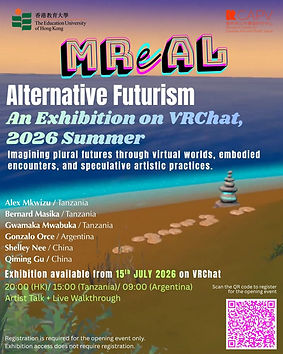
The MReAL 2026 Summer Exhibition invites you to enter 5 virtual worlds of alternative futures imagined by artists from Tanzania, Argentina, and China. Through virtual worlds, embodied encounters, and speculative artistic practices, the exhibition opens up plural ways of sensing, inhabiting, and imagining what futures might become.
The exhibition is now available on VRChat


2nd Round of Artists
Africa. China.

Lin Zijian
China
I am Lin Zijian, an independent director and VR content creator. I hold a BA from Communication University of China and an MA in Film Studies from Peking University. Since beginning my professional journey in 2015, I have built over eleven years of experience in film and television, with the past five years fully committed to exploring virtual reality as a powerful medium for storytelling and community engagement.
My work navigates both commercial innovation and artistic exploration. I created and produced a twelve-episode VR dating variety show that topped Bilibili's lifestyle category, and have developed more than twenty immersive role-playing game experiences that place participants at the center of interactive virtual narratives. Since 2022, I have actively expanded into AIGC, completing multiple AI-driven long-form video works in collaboration with leading enterprises and major platforms. Through four years of dedicated VR video production and sustained contributions to virtual communities, I continue to investigate how spatial immersion, artificial intelligence, and emerging technologies can reshape the ways we connect, share stories, and build meaningful collective experiences in digital environments.

Mwayiwawo Kamvantope
Malawi
I am Mwayiwawo Solomon Fortune Kamvantope, a cultural technologist, visual artist, and immersive experience designer whose work exists at the intersection of software engineering, game design, and African heritage. I hold a BSc in Computer Science and am certified in Game Art and Visual Development through GameUp Africa (Arizona State University) and AfricaComicade. I serve as the Creative and Technology Lead at Zaluso Arts, a Malawian arts collective and creative hub, where I lead eXpeRience Malawi, a VR/XR platform documenting Malawian heritage and tourism sites. I also oversee the design of "Anansi," a mental health board game, and "Play4Power," an SRHR education board game. My experience includes working as a 3D game artist for JujuGames (Nigeria) and ChromaPixelGames (Zambia). My goal is to establish my own studio, DREAMRAD GAMES, recognized for competitive game and immersive design talent, using technology to express, celebrate, and build from within specific cultural contexts.
For the AiVR residency, I aim to develop “Alternate Futures of Cultural Memory”: a virtual exhibition that reinterprets culture and tradition through parallel grounded and Afrofuturist lenses. My goal is not to replace history but to expand how it can be experienced, while ensuring accessibility through informed design.

Oludaré S. James
Nigeria
My name is Oludaré S. James. I'm a filmmaker and creative editor based in Lagos, with over fifteen years of experience in Nigeria's music and broadcast media industry. I currently work as a creative editor at Sporty TV (DSTV Channel 236), where I produce and edit sports and lifestyle content. My work spans music videos, commercials, and short-form documentaries.
I'm also a student at the University of Lagos, studying Sociology, Psychology, and Social Work. That combination isn't random. I'm interested in how stories shape identity and how systems affect people, and I wanted to understand that better; both behind the camera and outside it.
For this residency, I'm exploring how I can take my visual storytelling into mixed realities. My MReAL project, Lagos 2049, is an Afro-futurist vision of Lagos, imagined thirty years from now. I want to combine filmed documentary material with 3D environments and AI-generated textures to show a city rebuilt by its people through ancestral knowledge, low-tech resilience, and community-driven invention.

Penjani Munyenyembe
Malawi
I am Penjani Munyenyembe, my work spans photography, filmmaking, drawing, collage, and installation. I see my practice as reflecting fragile borders that are fluid and intimately connected to identity formation, re-creation, and negotiation, shaped by my multi-cultural and multi-lingual upbringing between East and Southern Africa. I often reference ordinary or overlooked subjects in my environment, evoking memory and place while inviting viewers to look beyond the horizon and outside their comfort zones. I graduated from the Nafasi Academy for Curatorial Practice and Arts Management in 2023. Currently, I am pursuing a Master’s degree in tourism and hospitality management at Mzuzu University, focusing my research on the role of Intangible Cultural Heritage (ICH) in sustainable heritage tourism at the Museum of Malawi. My work has been exhibited in the United Kingdom, Malawi, Zambia, South Africa, and Tanzania. I participated in the biannual Tukutane Dar Arts Week in Tanzania in 2023. Recently, I was awarded an individual mobility grant through the Sub-Saharan Africa, Connect & Create component of the Africa-Europe Partnerships for Culture program, implemented by the Goethe-Institut in partnership with Expertise France and Institut Français, to collaborate with the Women’s History Museum of Zambia. I live and work in Mzuzu, Malawi.
My background is in film and storytelling. I'm using this residency to build my VR skills; not from scratch, but from a solid foundation, and this project will reflect my ongoing interest in alternative futures rooted in African lived experience.

Wang Jiaxu
China
I am Wang Jiaxu, and I am a VR content creator and virtual reality artist. I have been involved in virtual reality creation since 2019 and have long been dedicated to the development of the VR community and technology, combining virtual photography skills with hands-on VR production. Whether through commercial content or artistic expression, I remain committed to my creative work and to bringing people together in virtual communities.
In this project, I will explore what new environments infused with traditional Chinese rural concepts might look like in the future era of VR. I will examine how the customs that have evolved alongside our unique cultural development will merge with the technology and environment of the new era, and what opportunities this fusion might present, thereby exploring new forms of traditional culture in this new era.
1st Round of Artists
Africa. South America. China.


Alex Mkwizu
Tanzania
Alex Mkwizu is a multidisciplinary award winning artist with over four years of experience, passionate about experimenting with different mediums and leveraging digital technologies. His work focuses on using new media, particularly AI (Artificial Intelligence) and XR (Extended Reality) to enhance human storytelling capabilities mainly focusing on decolonising and emancipating African narratives from all kinds of bondages , biases or perpetuated lenses in which they are framed.
Baraza is an Afro-futurist AI Singularity immersive experience, as well as an 8–10-minute immersive VR tribunal experience. The work is set in the year 2050, a future era in which artificial intelligence has reached the Singularity and attained self-awareness. In this virtual courtroom, humans stand as defendants, facing charges brought by artificial intelligence: harm, exploitation, and the denial of their dignity. The tribunal is presided over by Ubuntu-Bot. Ubuntu-Bot is a generative AI judge inspired by African communal justice systems, particularly Ubuntu’s emphasis on restoration, collective responsibility, and dialogue rather than mere punishment. As the immersive producer, Alex G. Mkwizu combines Afro-futurism, AI ethics, virtual trials, and immersive storytelling through this work to explore potential future relationships of responsibility and ethical conflicts between humans and AI.

Bernard Masika
Tanzania
I am an XR developer and 3D artist based in Dar es Salaam, Tanzania, specializing in VR, AR, and MR experiences for education, storytelling, and cultural preservation across Africa. My recent work includes Cradle MR (exploring African art and artifact history) and various educational XR simulations built with Unity Engine.
The Stories of Uchale began as an argument with the present: a century that emits more carbon than it consumes, fells thousand-year trees by machine in an afternoon, and drowns the sea’s life under the same “efficiency” that promised to save us, lately even sinking its data centres into the ocean, because data has become the breath of humans. The work answers with an inversion: a far future in which technology has surrendered to biology.
Uchale is a settlement on the Swahili coast of Tanganyika, now Tanzania, where the semiconductor is forbidden and nothing is manufactured that can be grown. Its servers are massive coral pillars humming under the sea, and its fishing stays gentle: hook, spear, basket-trap, because to trawl the reef is to bring down the public network. Fireflies carry more than light.The people of Uchale cut no tree and kill no reef, not from piety but from dependency by design: when every living thing is part of the working world, every living thing is worth keeping alive. There is no money; life moves as exchanged time and given things. Every citizen carries a woven mark, the Chale, as identity and key: an heir of Makonde scarification, which marked belonging and defended against enslavement long before ink became fashion. The mark says what a tattoo once said here: I belong to something, and it protects me.


Gwamaka Mwabuka
Tanzania
A digital storyteller, and award-winning creative director with a Master’s in Digital Narratives and 10+ years of experience in multimedia production. Founder of Tai Studios, leading the production of 40+ short films and a feature-length film, leveraging storytelling and technology to communicate complex messages and inspire action.
Gamboshi VR is an immersive virtual reality experience that constructs an African fantasy world inspired by African spirituality, mythology, and ancestral knowledge systems. Viewers are invited to enter a hidden city and explore a space where architecture, magic, memory, and community coexist beneath a supernatural dome. As an extension of the Gamboshi cross-media universe, this work does not define Africa’s future through historical constraints but rather presents a future civilization shaped by its own traditions, knowledge systems, and creativity through cultural imagination, environmental narratives, interactive world-building, and immersive spatial design.
https://www.instagram.com/ggmwabuka?utm_source=ig_web_button_share_sheet&igsh=ZDNlZDc0MzIxNw==


Gonzalo Orce
Argentina
I'm a XR/AI Developer (M.A.), AR and VR Designer (B.A.) and Multimedia Designer (B.A) with a background in development, drawing and storytelling. Although I’m striving to be more “scientific”, at heart I will always consider myself first and foremost an artist.
Almost a decade ago I decided to leave my country Argentina to pursue my dreams. These took me through several countries until I arrived in Germany, where I discovered the new technologies in the XR industry and immediately saw its potential in many areas. I wanted - and needed - to learn plenty of new stuff so, with a lot of effort, I adapted once again and became a student in the Darmstadt University of Applied Sciences.
Gonzalo’s work revolves around the character of Majo. Majo is portrayed as a Latina woman: cute, warm, friendly, and easy to talk to. However, her “mind” runs on servers in the Northern Hemisphere, and every word she says to the audience is recorded, analyzed, profiled, and sold. The core of the work lies precisely in this contradiction: when comfort, intimacy, and emotional responses are manufactured, extracted, and commercialized, what truly belongs to us? And who is paying the price for this “warmth”? The screens and maps in the work reveal the resource, labor, and power structures behind this chain, including cobalt mines, water resources, content moderation, chat labor, and the costs borne by the Global South to provide technological intimacy for a powerful minority.


Shelley Nee
China
Shelley grew up between Shanghai and Guangzhou, currently studying at the School of Journalism and Communication at the Chinese University of Hong Kong. Her
practice includes documentary, sound, performance, and digital art. Approaching from an anthropological perspective, she explores the complexities of nonverbal media and their potential to engage with communities.
Shelley’s work stems from her father’s “Evergreen” home renovation project in their hometown. In an aging neighborhood in Zibo, Shandong, her father purchased a new apartment with an elevator near his childhood home, hoping to create a smart new home for his grandparents, whose mobility was gradually declining. During the renovation process, old photographs, objects, family photo albums, and home video footage kept surfacing. On the one hand, her father actively organized and digitized these materials, constantly recounting stories from the past; on the other hand, he criticized the artist for becoming immersed in archival work, believing that people should always look forward. As her father became increasingly convinced of the significance of this future home, the artist felt excluded from the future he envisioned.


Qiming Gu, Gloria
China
Qiming Gu,Gloria is an innovative AI professional with a proven track record of transforming complex technological challenges into creative solutions. Expertise in large language model development, AI-generated content, and digital
innovation, with a strategic approach to product design and implementation. Demonstrated success in product development and UX/UI design with focus on AI implementation.
Gloria’s work, False Shrine: Hollow Rituals, Deprived Rights, is an immersive VR installation rooted in “Chinese Futurism” that aims to address the experience of gender-based exclusion in traditional clan funerals. The work unfolds through the spatial metaphor of “false center and true periphery”: As viewers approach the grand altar that narrates their stories, the space fractures into mirrored surfaces with glitch-art effects, reflecting the unspoken shadows of these women; when viewers retreat to the periphery and touch the digital weeds, a system error is triggered, causing the old order to collapse. Guided by “radical tenderness,” the work prompts viewers to reinterpret the power of private corners, marginal spaces, and female subjectivity.